So this is something which is close to my heart and actually has been since the turn of the century. I don’t think many people will be interested in it, but I thought I’d put it down anyway, and hopefully illustrate that what’s happening doesn’t need to be the way it is. But there are so many areas of society which are being damaged by bad choices that it’s right up there with decarbonisation. Society is being poisoned by a social media landscape which is driving people to extremes of thought, belief and action, and each cycle of it is reinforcing this. Yes, it really is this serious. And yet, this isn’t even really about social media.
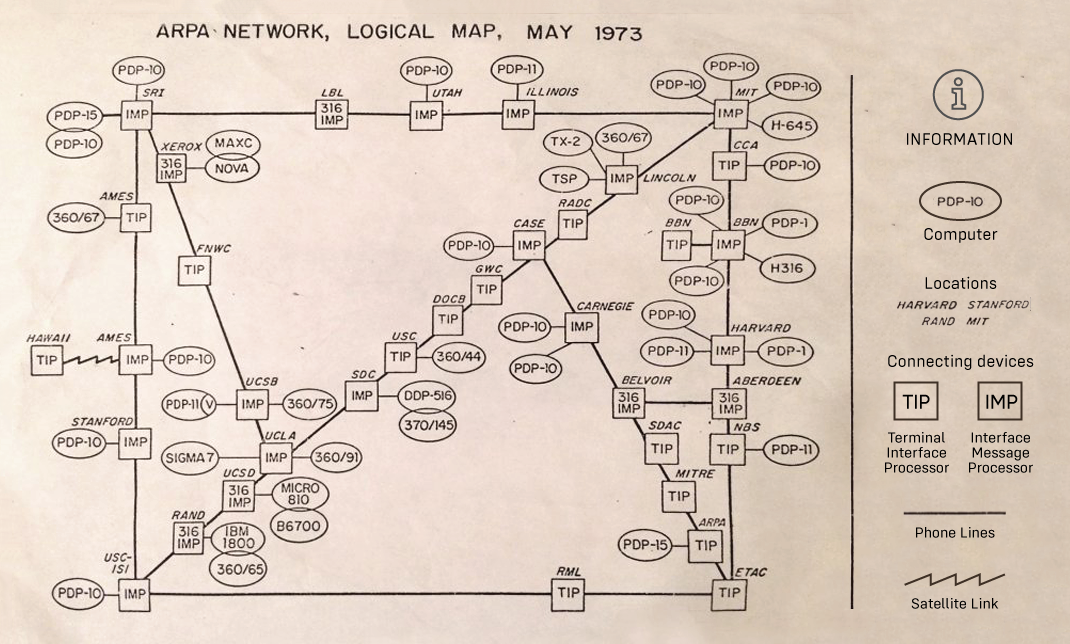
I would say the overall premise is that the Internet was originally concieved to be free. Not because of a tech ideal per se, but because it was designed to be an open, resilient government (and then international) project which allowed the free transfer of data between computers. There’s a map of the entire internet in 1973 here which shows all of the computers on it. From scant research, each of these computers is less powerful than a Raspberry Pi Zero that costs £15. So you could buy the entire internet for a few hundred quid now! But at the time, these were immensely expensive, cutting edge machines. That’s how far we’ve come…. There are more computers in most houses than this now (yes, yours too, we’ll get to that!).
Over time, the internet has grown and become usable by pretty much everyone. By the year 2000 it was ‘normal’ to be on the internet and people used it for day-to-day things such as email and so on. It became an intertwined part of everyone’s lives. All sorts of services popped up, flourished, died or got taken over, like a Cambrian explosion of ideas and ways of working.
But there were already two competing camps that have been around since the 80s – the OG people who shaped the computing revolution.
In one camp, there were companies like Microsoft, who made complete products and ecosystems and wanted you to buy into them, and use them, and have them make money – essentially capitalist techology companies. Nothing wrong with that per se in my mind. You don’t get to see or understand the software that’s running, buy you get to buy (well… licence) it, and use it. You can drive the car, but you can’t look under the bonnet, and if it needs fixing, you have to get them to fix it if they deem it worthy of fixing (such as a bug in Word). The bonnet is welded shut, and if you open it, they can take your car away. Yes, really (read the licence).
In the other camp, there is the “Free and Open” camp. Where all the software is fully open. This means if you want to (and you have the tech skills) you can get the code that actually makes the program work and change it to do what you want. You are free to use this version where and whenever you want, and there’s no stopping you from doing other things with it (licencing aside, which is a complex topic). This is often called Open Source.
One main problem with this model is that it’s difficult to make money from. So unless you’re a highly-driven hobbyist, are financially independent, or sponsored by someone who sees the bigger picture, progress can sometimes be slow.
But in short, for a long time there have been two camps – Open and Closed. Free or Walled Garden. All sorts of terms are used, and getting into the details isn’t what this is about.
The problem is that the asymmetry of power and finance means that almost no-one ‘normal’ (i.e. not a nerd like me) even knows that there is another road, let alone how on earth they would get there.
And getting there is not that simple, often for technical reasons to do with the hardware that systems run on, and the vested interests of the creators of that hardware to make you take the choices that they have decided on.
And even if you do decide that you want to make a change, it’s not that simple again for a couple of reasons.
But first, a quick diversion. Some people may have heard of something called ‘Linux’. It’s not easy to find out without spending a lot of time doing so, but I think it’s a vanishingly small fraction of the overall population. Compare that with knowing “Microsoft Windows” or “macOS”. And yet all three do the same thing – they are operating systems allowing computers to do meaningful work.
The thing that is funny about this is that in reality, you probably have multiple (small) computers/devices in your house running Linux. It provides many features that the modern internet needs (indeed it’s built pretty much around doing so). If you have an internet router, it’s running Linux. If you have an IoT device such as a fridge or washing machine that connects to the internet… Linux. Even some smart lighting systems. It is everywhere. And there are two reasons for this – it’s very good at its job. But probably the kicker is that it’s free so a company can download it, customise it for their purpose and ship a product which will have years of reliability and testing already built into the software running on it.
Here’s a quick list of surprise places:
- Smart Watches
- Cars
- Gaming (SteamOS)
- Most Website Hosting
- Apple Systems (macOS is built on a ‘cousin’ of Linux, anyway)
- NASA’s Supercomputer
- IoT Gadgets (cameras, white goods, etc).
- ChromeOS
It’s everywhere but almost no-one knows it. And why would they? It’s a bit like a fork. It does the job it’s supposed to, doesn’t shout about it, and no-one cares what does it as long as it works.
Those in the know also know they can replace Windows or macOS with a version of Linux such as Ubuntu which offers much the same experience (after a day or two of finding your way around) and gives access to a vast cataloge of free and open software you can run, much of which has enough features to use as an everyday replacement (such as replacing microsoft Word, which is still a huge cash cow for the company). All for the princely price of £0.00 if you choose to do so. Back in the late 90s, installing it was difficult. But now it’s as easy as reinstalling Windows… and doesn’t limit the hardware you put it on, unlike the Windows 11 specs which mean I have a super-powerful computer in my studio that’s “not allowed” to install Windows 11 because it lacks a couple of security features that I don’t care about but Microsoft says are essential. This has led to thousands of tonnes of eWaste and should be a permanent stain on the company’s reputation.
As the 2000s turned into the 2010s, things went further in the same direction. The walled gardens got more people in (by both fair means and foul) and the rise of social media accelerated all of this quickly – very quickly. The gardens are becoming more and more walled off, and more and more intent on keeping users in the one place for as long as possible as that’s what drives their business model. If they can keep you there, in short, they can show you more adverts – and someone else can show you fewer adverts. And they have spent billions on researching how to do this. How to make sure you take one more look at your phone. How to get you to watch another video. To scroll again, see if something is there to see. We’ve all done it and all felt hollow afterwards at some point. And then done it again. When there are 1000 people on the other side of a screen all working to find a weak spot in your mental armour and exploit it… it’s only a matter of time until it happens. To everyone. No-one is immune.
Since the 2010s ‘platforms’ have taken over in the internet. Facebook, YouTube, Instagram, WhatsApp, Twitter, etc. are all classed as platforms, which has an important distinction from a normal broadcaster. There is no legal comeback for the content they display. And this is an important part of what happens later on. While there were obviously other platforms which came and went, these are all ones which exist now and are major players in the space. And all of them are ‘closed’. They do not have the responsibilities of ‘mainstream media’, and with the rise of other areas such as podcasting and vlogging where there is very little regulation (and any that is present is toothless) has led to the current media landscape that the vast majority of people experience. Not only the avalability of content (which brings into your life more people and situations in a day than many people a few hundred years ago would meet in a lifetime), but the inescapability of the network effects of it. Everyone you know is probably on one of the platforms. They are entrenched, with other users that you want to contact on them.
You have two choices. Either go along with the flow, or take a stand and leave. Now I know most people just don’t leave. It’s difficult to do – all your friends and built up chat history, shared spaces, images and memories. This is often referred to as network effects. And the platforms have taken advantage of this to keep you where you are. There’s no technical reason that things have to be this way. This is a business decision.
So, it’s a simple “solution”….. You just have to walk away from all of it…. which of course next to no-one does and for good reason. It’s a guaranteed way for most people to feel bad by doing this, even if they feel they’ve done the ‘right’ thing in terms of no longer supporting a platform for whatever reason… and there are plenty of good reasons to do so. In no particular order, they have been responsible for:
- Inciting Genocide (Facebook in Myanmar)
- Knowingly continuing to promote content harmful to vulnerable teenagers (Instagram, even after internal investigation showed what was happening)
- Failing to remove violent and disturbing content in a timely manner (Live stream of an attack in NZ that left 50 dead).
- Failing to have moderators who even speak the language or know the culture they are moderating (in many cases having 2 for a market of millions of users).
The list goes on. It’s the same for Twitter (now X), YouTube and many others.
The stock response they give is that their business model does not provide enough income to allow the job to be done, and that it’s not their responsibility – they are merely a ‘platform’ to provide tools for responsible creators. Quite different from the broadcasters of old, who would be careful about everything they released, as they were on the hook if it went wrong.
All of this has been accelerated in nearly every diferection possible. Every company has been racing to monetise whatever they can about their users. A lot of this sounds like paranoia/tin foil hat stuff, but it’s all true, and easily proven:
- Smart TVs report back on what you’re watching. Not merely by saying “Steve put netflix on at 8pm” – that’s way too simple. But instead analysing the content that’s actually on screen, and matching it to known content and reporting back on that. If you have a DVD player attached to your TV and decide to watch series 4 of Babylon 5, then LG will know about it, and package and sell this information about it.
- Obviously all platforms report back on your viewing habits. I have
pi-holeinstalled on my home network which monitors and blocks this kind of traffic. And the top offenders in this? Netflix, iCloud, Google, Sonos… the list goes on. Everyone is playing the same game. Extract as much as possible from the client, in any way possible. - Facebook tracks everyone on the internet. Whether you have an account or not, or ever did. Everyone can be identified by a series of browser tricks. If, of course, you’re using Chrome, then Google knows everything you do all the time anyway – it’s game over. The same goes for Microsoft Edge (data goes to Microsoft), many of the ‘forks’ of Chrome (such as Brave) and so on. Only Firefox doesn’t do this, but you can still be tracked by others while using it due to the complexity of the modern web.
- Smartphone tracking. Everything you do is tracked and analysed. Yes, even if you’re on Apple. They are big on privacy in a way as they seem to only keep the data for their own needs and ad uses, but they are still doing it.
Now, we’re at a point where being locked in is becoming much more obvious – even to the layman. You can’t just take your facebook account and friends and move that ‘network’ to another network. The nearest thing to being able to do something like this is if you swap from Android to iOS or the other way, there are import/export tools which do a lot of the work for you, which is a nice convenience, but only really exists to lower the barrier to allow you to swap to another walled garden.
Imagine a real world where once you’d bought a house from Barrett and Barrett it was next to impossible to buy one from a private vendor instead? There would be uproar. Or if you bought a Ford and decided to change to VW and weren’t allowed. That’s kind of what’s happened in the tech world. It’s not impossible to change, but it’s much more difficult than it should be. And that’s not by accident, it’s by design. It would be technically not only possible but in many cases simple to allow movement from one to another, or even allow these platforms to talk to each other.
Quick case study. iMessage on iOS devices. Messages to third-party (OK, mostly Android) devices for years were shown as third-party citizens when talking to their Apple-running friends. Features missing and each speech bubble showed that the person on the other end was not ‘in the club’. The sadder thing about this was that Apple built a version of iMessage for Android, which worked exactly as it does on iOS. So people could enjoy the same experience and be in the club. But it was blocked directly by Craig Fedherighi at Apple. He didn’t want this as he felt it cheapened the iOS experience! Absolute tosh. Only recently have Android members of chats got some of those features (even though they could all be present now, technically).
And then… network effects. The main messenger platform that people use is WhatsApp. Which was humming along nicely as a little app, earning some money and being affordable for its users – charging $1 a year! It certainly wasn’t perfect, but it had plenty of traction. And more than Facebook Messenger was getting – people were using FB but not messaging on the platform. So Facebook (now Meta) buys it. The founders (who were in for a massive payout) ended up leaving without said payments because they didn’t agree with future changes they knew would be implemented (which we are now seeing – the integration of adverts, tracking of users).
Now many people will say “What’sApp messages are encrypted”. And they are. But that’s not the whole story. With the power of all the data at their hands, it’s possible for Meta to make very accurate analyses of what the content of the messages are, and they know who is communicating. Their wording around this is always very, very precise.
The only real alternative to this is a fully open-source future. Where not only the code that is being run is open, but the services themselves are open. i.e. if you want to , you could set up your own server (the code for all of that is provided) and use that to communicate via. Yes, definitely 0.001% niche behaviour, but it’s there. And the good thing about Open Source code is that it can be seen by everyone. Bugs are found by people who look at the code, or notice odd behaviour and work out what’s wrong. And then it can be fixed and put into action, making things better for everyone who uses it. Signal, for instance, is fully end-to-end-encrypted. The server doesn’t know who is talking to who. There’s no real reason for it to do so, unless you want to keep an eye on people. And WhatsApp is actually built on some of Signal’s code, which is a nerdy-funny punchline if nothing else.
The big problem with all of this? Friction. It takes more knowledge in many cases to either find the right service on the web (which afterwards could be the wrong one for some usage or technical reason), or if you want to run different sofware on your computer instead of Windows, there is a learning curve. And sometimes it can be steep:
- Getting the software in the first place. Often free, but then you need to know what to do with a
.isofile and how to make your computer run it and install everything. And what do you need to install? Most modern installers are much better than they used to be, but there’s always something that throws a spanner in at some point, and that an lead to head scratching or just plain giving up. I know I gave up plenty of times trying to install Linux as a ‘home server’ back in the late 90s (it was a lot less friendly then, believe me!), but somehow I stuck at it, and have had some form of home server ever since which has made storage of work files and printing and many other things much easier and simpler. - Understanding that stuff you used to do doesn’t work any more. There are several perfectly usable alternatives to MS Word such as libre office (you can even run them on Windows), but they do work slightly differently and there may be a little feature of something you loved that’s now missing.
- You may have an esoteric error that next to no-one has seen before, so help will be thin on the ground.
The upsides can be massively worth it though. Linux is available for desktop/laptop computers in many flavours, which are tuned to work on older machines, meaning a three year old laptop that’s creaking away under Windows will give another 5 years of good service. And the security is actually objectively better. Windows is badly written from the ground up, and that will never change. It’s plates stacked on spinning rods etc… and just not written to be secure.
Also, most distributions come with app stores now (even though the apps are free in many cases), making finding and installing sofware much easier than it used to be.
The Biggest Problem
The biggest problem is that all of this is entrenched -from people to small businesses to large businesses to entire governments. Schools are paying a fortune for Microsoft licences that shouldn’t exist, and be spending the money saved on education. Yes, there are specific pieces of software that use Windows and would need to carry on doing so, but for the run-of-the-mill PCs in classrooms (usually running Word and a browser), all of this could be free software with no licencing costs annually. But there’s a skills gap, and all school admins I saw (with the exception of T’s school running Chromebooks) were heavily invested in the Windows ecosystem – indeed the teachers all run Windows as they use SIMS and other software that’s windows only, and they have all their files on the Windows network…and they’re locked in. They’ve always done it that way, they’ll always do it that way, and there no way anyone’s putting their head above the parapet to say “Let’s change”.
But I think the forced integration of AI – that nearly everyone doesn’t need and has led to some issues around privacy, security and just not working properly means things may be changing. It is happening – maybe piece meal here and there, but it is – Lyon is doing it. Denmark is going to do it.
So, what’s the solution, smart guy?
OK, this totally comes from a position of what would be good in my opinion. I know it will not happen, it’s just a series of expanded shower thoughts, but based in probably 20 years of thinking about this at varying levels.
Firstly:
No public body should be using proprietary software or platforms. The BBC is a great institution (in my mind), but using X should not be happening. There are open, free alternatives, and the BBC should be using them, not X. They shouldn’t be using WhatsApp – they are actually adding to the problem by normalising this. The BBC is publicly funded, and should act as such. In the 80s, 90s and 2000s, it was an innovator. iPLayer was forward-thinking and ahead of many other platforms at a time when competing broadcasters had their heads in the sand. But now it appears to have lost direction and just go with the flow that everyone else does. If you’re Capital Radio or whatever, then that’s a private business decision. But there’s no reason that the BBC can’t just use a number for texts, and use email, and have a mastodon server that would replace their use of Twitter/X. Particularly given the politically charged nature of the man-baby who owns X, and how desperate the platform has become to try to make money by getting people to sign up.
This, to me, extends to state schools and government throughout – there needs to be a massive retraining program for ICT support in schools and local government that would allow the integration of Free and Open source software, saving millions each year to be spent on education and services rather than on Microsoft’s latest AI venture which no-one asked for.
Interchangeable Data. This is key. You should be able to take all your data – and I mean all of it – and take it to wherever you want. This happens to a degree at the moment, if you use Google Takeout or Facebook’s export (whatever it was I did when I left a decade or so ago). But you’re not getting all the data. You’re getting what you sent them, explicitly. You’re not getting any of the information they’ve scraped about you around the internet about all the sites you’ve visited, what all your preferences are that they have intimated from all of this data, etc. Yes, to 99.9999% that would be too much – and that’s fine. But you should be able to do it. So if you decided “I’m leaving facebook, I want to go do XXX” then you’d be able to download one file and then upload that file to the new place, and be done with it. It’s totally a technically solved problem – almost a trivial one, to be honest – but it isn’t available. Because it locks you into the network you’re in. And Zuck does not want that. Nor does Elon. Or Jeff, Tim, Sundar, or Satya. Or any of these people. Because it’s not in their interests, it would be in yours.
We have to start to pay to use services on the Internet. We’re already paying for all of this stuff, but not in a way that we see. Data is being gathered about your every move on the internet and sold to the highest bidder, and then used. Against you. Sounds paranoid, but it’s all about advertising. And if you’re someone who says that’s OK, remember that advertising isn’t about getting you to buy the right product for you any more. It’s about getting you to buy the product that the seller makes the most out of that matches closely enough for you to think thank you’re being sold what you want. I know that has always been the case with any sales task, but now it’s much more targeted with many more data points to work against, and with less interest in providing you with the right service or product than before. But that doesn’t actually mean you have to pay for everything, because of the next category of software…
Making use of (actually!) Open software. Open Source is a great thing. Without it, the internet wouldn’t be running at all. If everyone relied on Microsoft for their internet server software, it would be worse, slower, expensive and absolutely riddled with security issues. Quite the opposite of what we see today.
But it doesn’t just come down to software running in the background that is nothing to do with you. You can replace applications that you use on your computer that cost you money with an alternative that works for you rather than tries to funnel you into an eternal payment for it – even if you only use it twice a week! If you use Word now as you used to in the 90s or 2000s (in fact, probably almost any normal use!), then you don’t need to pay £105 a year for Microsoft 365. You can download LibreOffice, spend half an hour learning the slight differences in menus and functions (most of it is exactly as you’d expect in Word/Excel/etc), and spend the £105 you save each year on something nice. You’ll never get rug-pulled with a price hike that if you don’t pay it means you can’t open the document. Because the documents are open, and the software is open. So you can always just download it and you’re away. No, it doesn’t have AI integration with Copilot. But if you want to do that, you can – you can connect it to an AI and it can ‘help’ you if you want to work that way. Your software, your choice. Personally, I have found ChatGPT to be very useful when writing things that I find need sensitivity tuning, but they always need to be re-written by me, otherwise they are clearly just LLM-generated (there are many tells to this – here’s a pretty good video on doing so – but it’s definitely been useful).
Buy outright when possible. Take, for instance, Adobe’s licencing which changed a few years ago from a ‘buy once, you own a licence for life’ model to a ‘we are offering subscriptions’ to ‘we are now subscription only’. And of course Photoshop is total overkill for most users, but it was around £500 when it was last an outright purchase. Expensive, but professional. At normal prices, you would pay that in around 18 months, and then keep paying. There are cheaper alternatives that can still be bought outright (Affinity Photo is a good alternative at a sane price), but many people ‘know’ that they ‘need’ photoshop, so will buy it. To do something once a week or month, but once you’ve signed up, it’s easy to forget about. And if you’ve done all your work in it, it’s not just a case of cancelling and keeping your work. You may have it only in their cloud storage (another dark pattern that leads to you being locked in), but even if you have the file…. what are you going to open it up with? A new Photoshop subscription, that’s what. Look at the complete contrast to when I backed up my Skodarallyblog site. The files were backed up in open formats (SQL database and a .zip file of all the files). The only difficult thing about getting it up and running was that it was on a 15-years-out-of-date installation of WordPress. Which was still available to download and install and while I had some tech issues to overcome, it was all a case of looking up tech help from that era (which fortunately hadn’t been messed up with AI results), meaning all the hurdles I hit were jumpable once I’d found the right moves to do. This would simply not be possible today with closed sofware. The site would be gone forever.
Use your email address to sign up for accounts on third party sites – don’t use Google/Apple/x/Facebook to sign in. If you do, you’re giving away a lot, straight away, and making connections for these companies. Apple the the least of the offenders in this, but they still run their own advertising network. Something that most people don’t know… or certainly a lot more people did after they ran adverts for the F1 movie they have made inside Apple Wallet – probably the last place you’d think would make people trust you.
Don’t use ‘Cloud’ storage if you don’t have to. Microsoft is probably the worst for doing this behind your back – by default you can end up with all the files you think are on your computer actually stored in the cloud. And of course, this has advantages in some ways – if your computer/phone is lost or stolen then you have everything backed up and can just get a new one and restore from there. But knowing that’s what’s happening is important… and with the amount of data that we all generate with photos, videos, etc., it can get expensive storing everything there. But it’s convenient and that’s what’s driving people to do it. It’s cigarettes / junk food all over again, just with bits and bytes.
Algorithm Choice. On all social media sites, you are given zero choice over the algorithm that decides what you are shown. This is fine-tuned constantly, and optimises for only one thing – engagement – and it doesn’t matter if it’s positive or negative. You can move the needle a little. If you don’t like a video, just stop watching it. Don’t downvote it or comment, because that’s an interaction that has helped keep you there. This is what many YouTubers have now started hacking, by doing stupid things (when they are not stupid people), because they know that people will dislike it, and that will get them more views from more people – some of whom will like it, some who won’t but they’ll still get more interaction, so more views and so on. That’s why I’m starting to see more ‘definitely a terrible idea, this will never work‘ projects being done by Tavarish, a YouTuber who used to make good car videos. Now it appears he’s doing content hacking instead. Which is a pity.
Being given a choice of what to see, or what to favour – being able to tweak the dials of the algorithm, or choose a totally different one – would be a huge step forward. You could just have a facebook feed that was chronological, like back in the day. A YouTube feed which only showed videos with majority positive reactions (both in like/dislike and comment tone). TikTok feed that…. I dunno, I’ve never used it, but you get the idea. Rather than being micro-analysed and shown a lot of stuff you never want to see.
These are things that only government intervention would get to happen. The businesses would never do this, because it’s not in their interests to do so, it’s in yours. But it would be completely possible for this to be a legally-enforced thing. And you wouldn’t have to use it, you could just go default and be done with it. But being able to control what’s being shown to you seems like a basic right to me – if you ask for X and don’t get it, but don’t realise that’s what’s happening, then this is not a positive step for anyone other than the platforms.
Digital Ownership. Most of the things you buy, you don’t actually own, and haven’t for a long time. If you think you’ve bought some software, you will probably find out that you just bought a licence to use it. You don’t own the software, and if the publisher decides so, you are legally obliged to stop using it, and probably delete the media it came on. And this happens with digital music purchases. I wanted to do the right thing “back in the day” so I bought every piece of music I liked or needed. From a platform called 7 digital, which I liked – it worked well. And then I lost some of the tracks I bought, and went back there. And they were no longer available “due to licencing changes”. But do I get a refund? No. So I don’t own it, it was really just a rental the whole time when I was told I was buying it. So this is the reason now that if I want to watch a film, I’ll get a DVD from the charity shop, rip it and store it on my home server to watch whenever. This is legal providing I keep the DVD itself. And it can’t be taken back when someone changes their mind. But this is not something most people will do as it’s a geeky thing to do and 99% of people don’t have time to do that. If you are being told you’re buying something, you should be buying it. This is simple for music, but they have adopted the software licencing model and can legally stop you accessing something you think you bought.
Right to Repair. This is something which is again meaning you don’t actually own the thing you think you’ve bought. Cars are doing it (and it’s often said that it’s just EVs, but it’s all cars) – making it impossible to change simple parts (such as even the battery!) without access to special tools which will program the battery to the car. This is all done under the guise of “We’re making sure that this is safe… if anyone gets to change parts, they will cut corners and people will be in danger”. And it’s simply not true. So entire industries have grown up around circumventing these locks, and often then it just develops into an arms race.
But it shouldn’t be this way. If you create something, it should be mandatory that the way to change parts is made available. Apple has complied with this in the USA, but in a malicious way – they tooling they say you need is available, but difficult to get and expensive. Malicious compliance should also be stopped. Again, not something that’s easy to do, but it is possible. But they still make it difficult. If I took the screen from this macbook and swapped it over with one that was the next one off the production line it wouldn’t work. Because it’s been serial number locked and I need permission or software from Apple to allow this to happen.
Apple stops suppliers from making a perfectly run-of-the-mill chip (a power control one) available. It’s the same as another model, but the pins are swapped, so it does the same job, but you can’t buy one that breaks regularly – because Apple are actually quite poor in areas of hardware design for resilience. If you want to go down this particular rabbit hole, then I’d suggest looking at some Louis Rossman videos. He is all over this, and has put his money where his mouth is to try to get things changed.
And it’s not just high tech stuff. It’s things like John Deere Tractors! It’s everywhere. Because everyone is using the same MBA playbook. Because that’s how the VC companies do it. And they’re not doing it in your interests.
So, I’m going to stop here…. not because there isn’t more to say… but because this has become very long. There is so much more to this that needs to change. And all of it would make society better for pretty much everyone other than the 1% who are making money out of stiffing us at every opportunity. Because that’s the playbook now. Enshittification for all.
I know this was long and it’s unstructured… but I want to just put it out there and then…. it’s there if anyone wants to read it and has THREE WEEKS SPARE to so do.
Sorry! Thanks for getting here if you did!